

More than 1,500 women whose husbands have disappeared are in danger in Indian-administered Kashmir, report says.
The Indian government's refusal to officially recognise enforced disappearances has left families in perpetual limbo, promulgating stress and psychological trauma for parents, spouses and children, the report says [EPA]
The story of the half-widows of Kashmir "captures the unseen and pernicious face of insecurity in Kashmir", the report says.
More than 1,500 women whose husbands have disappeared but have not yet been declared deceased are in a precarious and dangerous position in Indian-administered Kashmir, according to a new report.
The 48-page report titled "Half Widow, Half Wife" released on Thursday by the Association of Parents of Disappeared Persons (APDP), argues that although "direct violence is disproportionately inflicted on males" in Kashmir, women and children whose husbands or fathers "disappear" are caught in a legal conundrum that does little to compensate or protect them.
The report says that the fact that the men have disappeared and have not been declared dead, has left thousands of women, known as "half-widows", and their children in a precarious state, with little legal protection, rendering many desperate and homeless and paving the way for abuse and exploitation.
Indian authorities claim that the disappeared men crossed over into Pakistan-administered Kashmir to complete arms training, became militants and never returned.
Local civil society and international human rights organisations dispute this claim and say that these men were abducted by Indian security forces and were either detained indefinitely or disposed of.
The Indian government's refusal to officially recognise enforced disappearances in Kashmir has left families in perpetual limbo, promulgating stress and psychological trauma for parents, spouses and children, the report says.
But for the "half-widows" it is particularly difficult.
The report says that based on their insecure position of being "single", yet still legally married, the "half-widows" are unable to access the family estate or ration cards. Even the ex-gratia relief and compassionate appointment created by the Indian government can only be accessed with a death certificate and that too only if it is proven that the deceased had no link with militancy.
Ex-gratia relief can only be accessed by "half-widows" after a period of seven years has passed and only when the case is passed through a local screening committee.
The report says that the committee is usually made up of police officers and those from government bureaucracy, thereby undermining the process.
"Most legal remedies remain elusive due to the severe financial and emotional costs over multiple year timelines," the report notes, adding that "administrative remedies fall short of providing due relief to half-widows".
But it is not just the state that places "roadblocks" in the way of the "half-widows".
"Half-widows" are undefined legally and within the patriarchal socio-cultural context of South Asia, the women find themselves at the mercy of Kashmiri society, where a deafening silence surrounds gender violence and abuse.
In rural Kashmir, with fewer economic opportunities, "half-widows" are at a greater risk of suffering manipulation by government officials and even community leaders.
Adding to the confusion is the continued dispute over what is the minimum time needed to dissolve a marriage and allow a "half-widow" to move on with her life and possibly remarry according to Islamic law.
One school suggests four to seven years, but others suggest that a "half-widow" is expected to wait up to 90 years before remarrying.
"The report is incredibly useful in linking the past with the present and future. In other words, it's not just about the mourning of a lost loved one, but it's about the deprivation that resulted from that loss till today because of government inaction.
"And, it's about the future of Kashmir. If Kashmir cannot reconcile with the past then what kind of future will it face?"
Omar Abdullah, the chief minister of Jammu and Kashmir, could not be reached for immediate comment.
Khurram Parvez, the programme co-ordinator from the Jammu and Kashmir Coalition of Civil Society (JKCCS), says that the most surprising finding of the report was the inaction of the state to the crisis.
"They [state authorities] have not moved, even years after the tragedies, which have ruined the past, present and future of so many families.
"The daily struggles of existence and seeking justice unabated, by these women have created examples of unflinching courage," Parvez said.
The report comes a day after India and Pakistan held peace talks in New Delhi for the first time since resuming bilateral talks this year.
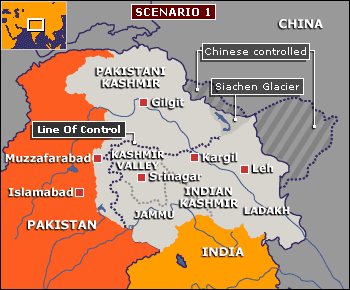
Somanahalli Mallaiah Krishna, India's foreign minister, and his Pakistani counterpart, Hina Rabbani Khar, held talks on Wednesday and spoke of entering a new era in relations, agreeing to work together to end the insurgency, to ease commerce and open travel across the Line of Control, dividing Indian-administered and Pakistan-administered Kashmir.
Indian newspapers were a little more reserved, with The Hindu editorial suggesting that the "talks broke no ground" and the "Kashmir-related confidence building measures announced by the two sides is meagre".
A Tehelka magazine article asking "Was it a successful diplomatic visit at all?" comments that "Pakistan foreign minister avoided tricky issues and refrained from mentioning Kashmir at the brief media interaction… it was left to Krishna to mention Pakistan's core concern".
Acharya said that the timing of the report could not have been any better.
"It sheds light on the past human rights violations and links them to the present. I have said that already, but I just wanted to reiterate that without the APDP and other groups campaigning [for] justice for the victims of the disappearances, then they will be forgotten by everyone (except the family members of course)."
But Acharya fears that the outcome of India-Pakistan talks will have little impact on human rights in Kashmir. He says that while Pakistani citizens have expressed concern for Kashmiri human rights, it is difficult to believe that the Pakistani government shares that sentiment.
"The Pakistani government obviously does not care, otherwise its actions would not have involved sending militants across the border to commit widespread human rights violations against Kashmiris.
"In fact, I would say that Pakistani involvement in Kashmiri matters has been nothing but a detriment to human rights and human rights advocacy on Kashmir."
Parvez agrees that the prevailing talks are unlikely to end human right violations in the valley. He says that the rights of the people in Jammu and Kashmir have been held hostage by the Indian government and the talks are still about relations between India and Pakistan and not about Kashmir.
"While India and Pakistan appear keen to take confidence building measures, initiating steps to build mechanisms to protect human rights of people should have been the priority, but unfortunately everything else has been prioritised over human rights."
Parvez says that one of the key recommendations of the report is that the Indian government repeal the draconian laws that give the armed forces impunity in Indian-administered Kashmir, including the Armed Forces Special Powers Act (AFSPA) and the Public Safety Act (PSA).
Furthermore, he says that a set of immediate recommendations calls on the government to create "a streamlined system of compensation without delays, harassment and coercion" and calls on religious scholars to reach a consensus on the minimum amount of time needed to pass before being declared a widow.
Crucially, the report calls for a special bench at the Jammu and Kashmir high court to hear cases related to the "half-widows" and for India to ratify a UN resolution on the protection of all persons from enforced disappearances.

Cherwan, Gurez (LoC) July 26: The 105-year-old Khalil Muhammad Lone living in the last village of this frontier village has not been able to cover a distance of 2-kilometres since 1947 to offer fateha at the grave of his sister, Mehri.
“It was nearly 15 years before the partition; my sister was married to Anwar of Dood-Gaghi. I would frequently visit Mehri’s home to inquire about her,” he said, adding that arrival of forces changed everything here. Recalling the fateful day, when Chorwan was separated from Dood Gaghi forever, Khalil says he was at his sister’s home on that day. “After remaining trapped on other side for a few days, I somehow managed to return,” he says. After a few years meetings between divided families’ on LoC were arranged by the officials of India and Pakistan. “My joy knew no bounds when it was my turn. I too went to the last post hoping to meet Mehri, but my entire joy fizzled out with the news of her death. I tried many times to visit her grave, but failed,” he says. And the only memory he has of his sister is that she had three daughters. “I don’t want to die before visiting her grave and meeting my nieces. I am too poor to afford the travel expenses to visit other side by bus or other means of transport. I want to cross the mountain to reach Dood Gaghi, which I used to do in the childhood,” he said. “Our miseries started in 1947 and we are continuing to live with it. From 1947 onwards we witnessed wars and exchange of artillery between forces of both the countries. During 1965 and 1971 wars, we would pray for the safety of our lives and most of the villagers would flee,” he said, adding that continuous shelling between the forces on LoC was nightmare for them, till announcement of the ceasefire by both the countries in 2003. “During these years, shells landed in our houses and courtyards. We couldn’t cultivate crops and even we walked cautiously in daytime as the danger of death lurked every time,” he added.
It is time to take stock of the situation and hold those accountable who have turned a genuine rights movement into a ‘free house’ for a free drink
Dr Syed Nazir Gilani
It would a statement of facts to say that after militancy and politics, the third ‘component’ of diplomacy used in advancing the Kashmir case has suddenly entered into a cul de sac. The manner and character of the diplomatic work agreed in an expressed or at times unexpressed manner by Hurriyat and Pakistan has become subject of a criminal complaint before the United States District Court for the Eastern District of Virginia, United States of America.
It would a statement of facts to say that after militancy and politics, the third ‘component’ of diplomacy used in advancing the Kashmir case has suddenly entered into a cul de sac. The manner and character of the diplomatic work agreed in an expressed or at times unexpressed manner by Hurriyat and Pakistan has become subject of a criminal complaint before the United States District Court for the Eastern District of Virginia, United States of America.
A criminal complaint has been lodged by a Special Agent, Federal Bureau of Investigation, against Dr Syed Ghulam Nabi Fai and Zaheer Ahmad for “conspiracy to act as an agent of a foreign principal without registering with the Attorney General and to falsify, conceal and cover up material by tricks, schemes and devices, in matters within the jurisdiction of agencies of the executive branch of the Government of the United States”. The broad spread of the work being done by the three Kashmir Centres in Washington, London and Brussels and their three incharges are identified in a manner which of course has remained the concern of many of us who understand the jurisprudence of Kashmir case, remain close to the day to day life of the people (not leaders) and who have a pre-1990 commitment with the Rights Movement.
Dr Fai has been accused as an American citizen to have violated the Laws of his country. We can’t do much about it other than seek to secure a proper legal defence and of course there would be plenty of it, even if not for him but for many other reasons. At the very outset one should not seek or think to compromise on the principle that in addition to being an American citizen, he continues to remain a State Subject of the State of Jammu and Kashmir. If it were a world of rule of law and the supremacy of Constitution, the three governments of Kashmir at Srinagar, Muzaffarabad and Gilgit should have an interest in the arrest of Dr Fai and ensure that a Kashmiri does not suffer any disadvantage in his difficult days. Kashmiri diaspora also have a duty to make sure that he is not left to himself and made a scapegoat, while the regime does not halt to see the harm done in Kashmir to the people, habitat and the right of self-determination.
We have no reason to celebrate the situation. However, it is high time to sit undisturbed and revisit our work on Kashmir and admit that the regime which has been controlling the politics, militancy and diplomacy on Kashmir has failed. People of Kashmir have been recruited to follow a certain script and unless the text of the play in all Acts written and organised by using the manner of Kashmiri punctuation, Pakistan would arrest Raymond Davis and Americans would reply in no different manner. We have Kashmiri Raymond Davis’s as well. For every American or Kashmiri Raymond Davis there has to be a date. I have love and respect for Dr Ghulam Nabi Fai, not for the manner and character of his work but for the simple fact that he is a Kashmiri and I have known him as a decent human person since early 1970s.
It is no surprise that Pakistan, Hurriyat and some others who remain in close proximity to the Principal’s who look after Kashmir affairs took a little while to formulate their response. There was more to lose in going silent or stepping back on the arrest. Therefore, Government of Pakistan, which in this case means establishment, had no choice but to make some noise. It was picked up by our political leaders on both sides of LoC.
Dr Fai should not be left to his fate in these criminal proceedings in USA. We should see to it that in addition to his rights as an American national he has the warmth of our moral support, not because he is a good ambassador of Kashmir, but because he is a Kashmiri and we may make many mistakes in the course of our struggle for self-determination. We should not leave it to the process in the United States District Court in Virginia but take it to the Court of the people of Kashmir.
The 131 paragraphs of the affidavit spread over 44 pages do not make a good reading. They disturb and make one feel very low. One is left with a feeling of bitterness to know that we have continued to wear disguises in the name of Kashmir and have done harm to the right of self-determination far more than anyone else. It is unfortunate that after 1990 our political, militant and diplomatic components of the Rights Movement have been exposed and weakened one after the other. These three variables do need finances and support but they have a choice to engage India and Pakistan (as the case may be) as allies and not as their agents as described in the criminal complaint filed against Dr Fai.
If he has remained in charge of any financial and other trust on behalf of the people of Kashmir, it is unacceptable if he had not the choice in the manner of seeking to enhance the constituency which could have been sympathetic to the cause of Kashmir. A portion of finances in rights movement may suffer a natural loss or may not be well spent. But one should not lose the sight of the fact that this money should advance the cause and earn some relief for the suffering individuals in all parts of Kashmir or many others in the diaspora who have suffered on account of a political, militant and diplomatic script written by a section in the establishment in Islamabad. Establishment has found power, prestige and money in Kashmir and would practice any trick in the book to recruit their ‘ambassadors’ in and outside Kashmir.
It is here that every common Kashmiri has a duty to intervene and interfere. It may seem difficult at one point that individuals or institutions who stand at variance to the establishment in Islamabad and continue to remain on the side of the jurisprudence of Kashmir case and the people may not be able to match up resources of the establishment, does not always mean that we should all turn into ‘conformists’. We have a duty to our conscience, principles and above all our people. Dr Fai’s arrest has a lesson for us that circumstances alter cases. We need to make every effort that Dr Fai is released as early as possible and we should examine all the 131 paras of the affidavit filed in the criminal case in a manner that fits the character of a responsible nation.
We should not let the establishment in Pakistan (or India) appoint people for us to conduct politics, militancy and diplomatic work in the manner described in the affidavit of Special Agent, Federal Bureau of Investigation. We need to seek alliances with allies and resist to become agents in any manner. Hurriyat leadership and others who remain involved in various disciplines of life in Kashmir need to update their understanding of the Kashmir case. Hurriyat by virtue of its Constitution should appear to be representing all the people of Jammu and Kashmir, regardless of their political belief. Deep down in their hearts they are free to harbour a desire to join India, Pakistan or remain independent but prima facie their role has to appear all inclusive.
We have to move beyond the scripted roles delegated to our leadership in all the three components of the movement. It is time to take stock of the situation and hold those accountable who have turned a genuine rights movement into a ‘free house’ for a free drink. The blood of a generation is on our hands. We remain liable and accountable. Establishment shall have to appear in the court of common interest and we may have to take them to other international forums for the harm that their policies have caused to the people, habitat and self-determination. My thoughts are with Dr Fai and he should remain assured that establishment would be doing a favour to itself by putting all support in order for his robust defence. It does not mean we shall not summon Dr Fai in a court of public interest to explain various matters arising out of the US criminal complaint.
Author is London based Secretary General of JKCHR – NGO in Special Consultative Status with the United Nations and can be mailed at dr-nazirgilani@jkchr.com
Dr Fai has been accused as an American citizen to have violated the Laws of his country. We can’t do much about it other than seek to secure a proper legal defence and of course there would be plenty of it, even if not for him but for many other reasons. At the very outset one should not seek or think to compromise on the principle that in addition to being an American citizen, he continues to remain a State Subject of the State of Jammu and Kashmir. If it were a world of rule of law and the supremacy of Constitution, the three governments of Kashmir at Srinagar, Muzaffarabad and Gilgit should have an interest in the arrest of Dr Fai and ensure that a Kashmiri does not suffer any disadvantage in his difficult days. Kashmiri diaspora also have a duty to make sure that he is not left to himself and made a scapegoat, while the regime does not halt to see the harm done in Kashmir to the people, habitat and the right of self-determination.
We have no reason to celebrate the situation. However, it is high time to sit undisturbed and revisit our work on Kashmir and admit that the regime which has been controlling the politics, militancy and diplomacy on Kashmir has failed. People of Kashmir have been recruited to follow a certain script and unless the text of the play in all Acts written and organised by using the manner of Kashmiri punctuation, Pakistan would arrest Raymond Davis and Americans would reply in no different manner. We have Kashmiri Raymond Davis’s as well. For every American or Kashmiri Raymond Davis there has to be a date. I have love and respect for Dr Ghulam Nabi Fai, not for the manner and character of his work but for the simple fact that he is a Kashmiri and I have known him as a decent human person since early 1970s.
It is no surprise that Pakistan, Hurriyat and some others who remain in close proximity to the Principal’s who look after Kashmir affairs took a little while to formulate their response. There was more to lose in going silent or stepping back on the arrest. Therefore, Government of Pakistan, which in this case means establishment, had no choice but to make some noise. It was picked up by our political leaders on both sides of LoC.
Dr Fai should not be left to his fate in these criminal proceedings in USA. We should see to it that in addition to his rights as an American national he has the warmth of our moral support, not because he is a good ambassador of Kashmir, but because he is a Kashmiri and we may make many mistakes in the course of our struggle for self-determination. We should not leave it to the process in the United States District Court in Virginia but take it to the Court of the people of Kashmir.
The 131 paragraphs of the affidavit spread over 44 pages do not make a good reading. They disturb and make one feel very low. One is left with a feeling of bitterness to know that we have continued to wear disguises in the name of Kashmir and have done harm to the right of self-determination far more than anyone else. It is unfortunate that after 1990 our political, militant and diplomatic components of the Rights Movement have been exposed and weakened one after the other. These three variables do need finances and support but they have a choice to engage India and Pakistan (as the case may be) as allies and not as their agents as described in the criminal complaint filed against Dr Fai.
If he has remained in charge of any financial and other trust on behalf of the people of Kashmir, it is unacceptable if he had not the choice in the manner of seeking to enhance the constituency which could have been sympathetic to the cause of Kashmir. A portion of finances in rights movement may suffer a natural loss or may not be well spent. But one should not lose the sight of the fact that this money should advance the cause and earn some relief for the suffering individuals in all parts of Kashmir or many others in the diaspora who have suffered on account of a political, militant and diplomatic script written by a section in the establishment in Islamabad. Establishment has found power, prestige and money in Kashmir and would practice any trick in the book to recruit their ‘ambassadors’ in and outside Kashmir.
It is here that every common Kashmiri has a duty to intervene and interfere. It may seem difficult at one point that individuals or institutions who stand at variance to the establishment in Islamabad and continue to remain on the side of the jurisprudence of Kashmir case and the people may not be able to match up resources of the establishment, does not always mean that we should all turn into ‘conformists’. We have a duty to our conscience, principles and above all our people. Dr Fai’s arrest has a lesson for us that circumstances alter cases. We need to make every effort that Dr Fai is released as early as possible and we should examine all the 131 paras of the affidavit filed in the criminal case in a manner that fits the character of a responsible nation.
We should not let the establishment in Pakistan (or India) appoint people for us to conduct politics, militancy and diplomatic work in the manner described in the affidavit of Special Agent, Federal Bureau of Investigation. We need to seek alliances with allies and resist to become agents in any manner. Hurriyat leadership and others who remain involved in various disciplines of life in Kashmir need to update their understanding of the Kashmir case. Hurriyat by virtue of its Constitution should appear to be representing all the people of Jammu and Kashmir, regardless of their political belief. Deep down in their hearts they are free to harbour a desire to join India, Pakistan or remain independent but prima facie their role has to appear all inclusive.
We have to move beyond the scripted roles delegated to our leadership in all the three components of the movement. It is time to take stock of the situation and hold those accountable who have turned a genuine rights movement into a ‘free house’ for a free drink. The blood of a generation is on our hands. We remain liable and accountable. Establishment shall have to appear in the court of common interest and we may have to take them to other international forums for the harm that their policies have caused to the people, habitat and self-determination. My thoughts are with Dr Fai and he should remain assured that establishment would be doing a favour to itself by putting all support in order for his robust defence. It does not mean we shall not summon Dr Fai in a court of public interest to explain various matters arising out of the US criminal complaint.
Author is London based Secretary General of JKCHR – NGO in Special Consultative Status with the United Nations and can be mailed at dr-nazirgilani@jkchr.com
Victim Records Statement Before MoS Home, DGP; Case Filed Against Army

Damhal Hanjipora (Kulgam), July 21: Protests erupted in south Kashmir’s Kulgam district on Thursday after a woman was allegedly gang raped by army personnel. The victim recorded her statement before Minister of State for Home and Director General of Police who flew to the area after massive protests.
POLICE REGISTERS CASE “Police have registered a case FIR No:-66/2011 under section 366,376-RPC in Police Station Damhal Hanji Pora, into an alleged abduction and rape of a lady,” a police spokesman said in a statement.“At about 1300 hours one Rukaya Banoo wife of Muhammad Lateef Bhat of Gujjardhar Manzgam, presently at Bhek-Chiranbal, came to Police Sation D H Pora accompanied by her brother- in-law and reported that on July 19 (Tuesday), at about 7 pm in the evening, when she was returning from a nearby spring to her home, two persons in security force uniform appeared in her way. Both were carrying weapons and forced her to accompany them to Jungle. The duo kept her in a dhok and raped her. There were some utensils and one of them would make tea in another dhok. They would take biscuits and didn’t give anything to her. Both of them were sporting beard. They would talk to her in Gojri, and with each other the exchanged different languages. They left her today morning and she reached her home and informed her brother in law-Shah Wali Bhat the whole incident,” the spokesman added.“On this report, Police have registered a case and a Special Investigation Team has been constituted to investigate the matter,” he added.The team, sources said, is headed by Additional Superintendent of Police (ASP), Kulgam, Muhammad Shafi Mir. He will be assisted by DySP and Station House Officer (SHO) Damhal Hanjipora.Meanwhile, Family members of the victim said that on Tuesday evening she had gone to perform ablution nearby her hut before she could go for evening prayers, when two army men allegedly abducted her. “The army personnel after taking her along kept her confined in a hut in the nearby Kadalbal forests for nearly 36 hours till Thursday morning,” they alleged, adding that she returned home this morning alleging that she was gang raped by the soldiers.Quoting the victim, the family said the army men before leaving her threatened her of dire consequences in case she reported the incident to any one.“I can identify both the army men,” the family members quoted the victim as having said.They said the victim was in a state of shock and returned to her home while dragging herself from the forests.As the word about the gang rape spread in the area, hundreds of people including women and children took to streets at Manzgam village and staged pro-freedom demonstrations.The protesters were demanding stringent action against the accused soldiers. People burnt tyres on roads as a mark of protest while the shops were closed and traffic was halted. Police reached the spot and assured the people of stern action against the culprits.VICTIM RECORDS STATEMENT BEFORE MOS HOME, DGPMinister of State for Home, Nasir Aslam Wani, and Director General of Police, Kuldeep Khoda, immediately flew to the village and met the victim. The victim reiterated her statement in presence of MoS Home, DGP, DC Kulgam and Social Welfare Minister and local MLA Sakina Itoo.“I can identify the soldiers. They were in uniform and had guns and wireless sets with them,” the victim told the dignitaries.Incidentally, Chief Minister Omar Abdullah and Former Chief Minister Mufti Muhammad Sayed were both present in Kulgam district on Thursday and addressed parallel rallies.ASP Kulgam, Muhammad Shafi Mir, told Greater Kashmir, “The victim’s medical examination has been conducted at the district hospital Kulgam and a DNA examination will also be done,” Mir said.Army spokesman Lt Col JS Brar told Greater Kashmir, “Allegations have been made. Police is probing the matter.”MLA Kulgam M Y Tarigami condemned the incident and demanded a magisterial inquiry to probe the allegations of the woman.Peoples Democratic Party (PDP) has demanded a thorough probe into the incident.Condemning the incident, a PDP spokesman said this was yet another instance of lawlessness that has made lives and honour of the people insecure. He said such incidents are on a rise and the government seems to be ignoring the atrocities that are committed almost every day on the weak and vulnerable.The spokesman said a thorough probe and investigations must be taken up immediately into the incident. Full facts should be brought out and the culprits involved in this and earlier such incidents should be brought to book and given severe punishment.
Kashmiri Pandit Returns With Sweets After 21 Years

Srinagar, July 10: Twenty one years back, he would give sweets to children whom he would prescribe medicine at his medical store at Hazratbal on the Srinagar outskirts. Today, he roamed around the place with toffees for everyone who received him with hugs, kisses and shake-hands.
For Kashmiri Pandit, Ganga Prasad—also known by the Kashmiri names like Hitta, Bamber and Kachur—almost the entire Hazratbal was waiting this afternoon to see him. “God knows better how happy I am to return to this place,” Prasad told Greater Kashmir, as he was greeted by his friends and well-wishers in a locality. “I can’t express this happiness in words. I am getting the same love that I would get when I left the Valley in 1989.”
Today, people of Hazratbal, including women and young children, greeted Prasad and took him to their homes. “I visited Kashmir with a specific purpose this time. I wanted to pay obeisance at Dargah Hazratbal which was my desire since I left this place,” he says, as he sips a cup of tea in a friend’s place at Hazratbal. “For the past few days, I visited some shrines in Kashmir and also Khir Bhawani Temple at Tulmulla. In next few days, I am going to Charar-e-Sharief shrine and the shrine at Baba Reshi in Gulmarg.”
Prasad has visited Kashmir along with his daughter and son-in law—who are here in connection with the Golden Jubilee Celebrations at Government Medical College Srinagar. “After 1989, I lived in Jammu for a year. Then my daughter and son-in-law purchased a flat for me in Delhi where I lived for 10 years. Then I shifted to Mohali, Chandigarh,” Prasad said.
Prasad’s medical shop named “New Cash Chemists and Druggists”, according to obsevers, would be a famous medical store in Hazratbal. “Whenever we took children to the store for injection purposes or medication, Hitta (Prasad) would give them a 10 paisa coin and some sugar to make them happy,” said Prasad’s friend, Farooq Ahmad, who runs a grocery adjacent to the erstwhile medical store. “We are glad to see him in the Valley again.”
Today, many children, whom Prasad had given the sweets, have grown up and were among those who greeted him.
Prasad said he missed the Ziyarat (holy relic) at Dargah Hazratbal all these years. “I see a new Kashmir this time, which has developed to a great extent,” he says, in response to a question on whether he feels any change in Kashmir.
Prasad, who would live at Jawahar Nagar, says he can’t comment on whether he’ll return to the Valley permanently or not. “Who knows if I will return,” he said. “I have already sold the house in Jawahar Nagar. I am extremely glad to be back. But my return to Kashmir has fulfilled my desire to visit back the shrines in the Valley.”
Today, people of Hazratbal, including women and young children, greeted Prasad and took him to their homes. “I visited Kashmir with a specific purpose this time. I wanted to pay obeisance at Dargah Hazratbal which was my desire since I left this place,” he says, as he sips a cup of tea in a friend’s place at Hazratbal. “For the past few days, I visited some shrines in Kashmir and also Khir Bhawani Temple at Tulmulla. In next few days, I am going to Charar-e-Sharief shrine and the shrine at Baba Reshi in Gulmarg.”
Prasad has visited Kashmir along with his daughter and son-in law—who are here in connection with the Golden Jubilee Celebrations at Government Medical College Srinagar. “After 1989, I lived in Jammu for a year. Then my daughter and son-in-law purchased a flat for me in Delhi where I lived for 10 years. Then I shifted to Mohali, Chandigarh,” Prasad said.
Prasad’s medical shop named “New Cash Chemists and Druggists”, according to obsevers, would be a famous medical store in Hazratbal. “Whenever we took children to the store for injection purposes or medication, Hitta (Prasad) would give them a 10 paisa coin and some sugar to make them happy,” said Prasad’s friend, Farooq Ahmad, who runs a grocery adjacent to the erstwhile medical store. “We are glad to see him in the Valley again.”
Today, many children, whom Prasad had given the sweets, have grown up and were among those who greeted him.
Prasad said he missed the Ziyarat (holy relic) at Dargah Hazratbal all these years. “I see a new Kashmir this time, which has developed to a great extent,” he says, in response to a question on whether he feels any change in Kashmir.
Prasad, who would live at Jawahar Nagar, says he can’t comment on whether he’ll return to the Valley permanently or not. “Who knows if I will return,” he said. “I have already sold the house in Jawahar Nagar. I am extremely glad to be back. But my return to Kashmir has fulfilled my desire to visit back the shrines in the Valley.”
Jammu, July 7: A "great earthquake" measuring eight or above on the Richter scale may rock Jammu and Kashmir by 2055, a geologist warned on Thursday.
The state was hit by a 7.6 intensity quake in 2005, with epicentre around Muzaffarabad in Pakistan Administered Kashmir (PaK), killing over 100,000 people.
G M Bhat of Jammu University, who has undertaken extensive study in seismology, said, “Rough calculations indicate that 'Great Earthquake' happen every 500 years. The records show the last one occurred in 1555 in the Kashmir seismic gap of the Himalayan range."
He said Roger Bilham, professor of Geology at the University of Colorado, has also mentioned in his study that the last "great earthquake" occurred in the Kashmir gap in 1555 and before the next one, a smaller earthquake of 7.6 intensity rocked this gap (in 2005).
"Studying this pattern we can say that a 'great earthquake' can rock Kashmir by or before 2055," Bhat said.
The Himalayan zone is divided into three seismic gaps - Kashmir, Central and Assam. Jammu and Kashmir, Himachal Pradesh and Uttrakhand fall under Kashmir gap that falls in the highest risk zone.
The Himalayan zone is divided into three seismic gaps - Kashmir, Central and Assam. Jammu and Kashmir, Himachal Pradesh and Uttrakhand fall under Kashmir gap that falls in the highest risk zone.
Bhat said during 2005 earthquake only one-tenth of the elastic energy under the earth was released. "As nine-tenth energy is still held inside, the 'Great Earthquake' can happen before 2055."

Srinagar, July 4: Barely five days after the start of the annual Amarnath Yatra, the mismanagement by the Jammu and Kashmir Government and Shri Amarnath Shrine Board is clearly visible on ground. In an attempt to diffuse the mounting chaos, the SASB has now issued an advisory, asking the pilgrims to not embark on the Yatra unless they are formally registered.
While police and the SASB officials are grappling to plug the inflow of unregistered pilgrims from Jammu to Kashmir, the piling up of pilgrims at the Base Camps at Baltal and Pahalgam has triggered a chaos.Highly placed sources disclosed to Greater Kashmir that thousands of unregistered pilgrims have already reached the Valley, taking the SASB and the Government agencies by surprise. “Given the inflow of unregistered pilgrims, there seems to be a severe breach in checking mechanism on the Srinagar-Jammu highway,” a top government official, wishing anonymity, told Greater Kashmir. “These pilgrims are reaching the Base Camps, triggering chaos and confusion. This is ultimately affecting the smooth conduct of Yatra and the overall service delivery. The Yatris are fuming over this mess.”The mismanagement has put a huge question mark on the checking mechanism at different places on the 300-km long Srinagar-Jammu highway. “In just five days, there seems to be the inflow of thousands of pilgrims, most of whom are unregistered. This is certainly going to put a huge strain on the service-delivery and raise environmental concerns,” the official said. “And if any untoward thing happens, the Government shall be held responsible for that.”Pertinently, this year the state government curtailed the Yatra period by 15 days in view of the safety of pilgrims along the cave route, which happens to be slippery most of the time due to inclement weather. While the government move has been by and large hailed by the cross section of society, the inflow of unregistered Yatris is causing a disappointment of sorts. “One the one hand the Government voiced concern over the safety of pilgrims and promised better facilities for them. But on the other, there seems to be no check on the registration of pilgrims. The inflow of extra pilgrims is certainly going to raise more safety concerns and cause mismanagement,” said a SASB official, insisting not to be named. “The problem gets compounded by the frequent rainfall which leads to suspension of the Yatra and the stranding of pilgrims at the Base Camps.”A group of Yatris Monday called this newspaper, asserting that they were suffering because of the unregistered pilgrims. “Despite having the registration documents, we were made to wait for hours near Nagrota. That is because there was a long line of unregistered pilgrims arguing with policemen. The system of checking is completely flawed,” they said. “Some unregistered pilgrims are entering the Valley in the garb of being tourists. They later end up in the Yatra Base Camps. This mess needs to be looked into because it is also hampering flow of normal traffic on the highway.”In official estimation, around 5000 pilgrims were to be allowed from Jammu to Kashmir on daily basis. But, the officials said, the figure seems to very high.PERMISSION MUST: SASBInterestingly, SASB on Monday issued an advisory, making a clear reference to the inflow of unregistered pilgrims to Kashmir. The advisory said the SASB’s Chief Executive Officer RK Goyal has “once again appealed to all those who intend to undertake the pilgrimage to the shrine of Shri Amarnathji to complete the necessary registration formalities and obtain a Yatra Permit before embarking on the pilgrimage to avoid facing inconvenience on arrival in the state.”“The pilgrims must embark on the Yatra strictly as per the dates and the routes specified in their Yatra Permits,” Goyal said, asserting that for the Shrine Board’s planning to provide a smooth and a hassle-free Yatra for all pilgrims to be successful, “it is also the responsibility of every Yatri to display the required discipline and, first of all, obtain a Yatra Permit.”WE ARE AT IT: DIV COMThe Divisional Commissioner Kashmir, Asghar Samoon, said the registration is done by the SASB. “Our policy as administration is to allow the registered Yatris to visit the tourist spots in Kashmir as well. But there are some pilgrims who come here in the garb of being tourists. Other issue is that some Yatris visit the cave via Pahalgam and return by Baltal. There is a carrying capacity at the Base Camps. And if more people are allowed, it will certainly trigger chaos and confusion,” he told Greater Kashmir.
Subscribe to:
Posts (Atom)


